So I just received a package from the Dicebag Lady. Inside were a set of eight shieldmaidens for my Viking Army! They got here loads faster than I expected, seeing as they were coming from England, or it's because I actually forgot when I ordered them.
I ordered the Shield Maiden Warriors and the Shield Maiden Fighters. The models are in the standard white metal and are very nice sculpts, though the Warriors appear to be a bit more in the exaggerated/cartoonish style, but I don't mind because I like variety in my armies.
They had very minimal mold lines and were very easy to clean up. But knowing me I'll probably find more as I start to paint them. All in all they are very beautiful models, also very beautiful ladies. I look forward to mixing them into the ranks of my Vikings! I'll be posting pictures as soon as they are painted.
I would have to rank them at a 4.5 out of 5. I'm very impressed, and will most defiantly be ordering more models from her.
She has all sorts of models of realistic females! I had stumbled across the site while searching for shield-maidens, and I've been very impressed with her collection of models. If you are sick of female models with unrealistic/revealing armour, definitely take a visit to the Dicebag Lady!

Wednesday, May 25, 2016

Thursday, May 12, 2016
40K Battle Report: The Lost Temple (Space Marines vs Orks 2500pts)

Detecting anomalous readings from a ruined temple on the outskirts of an ancient imperial settlement, the 5th company of the Tempest Lords space marines were dispatched to investigate. Upon arrival, they discovered that the planet was occupied by ork forces lead by non other than Ghazghkull Mag Uruk Thraka, the Beast of Armageddon.

Both forces approached the ruined temple, presenting a broad front. The heavy support elements of the Tempest Lords set up in a ruined building and fortification, the scout elements advanced on the temple, and the remainder of the company advanced in force embarked on their transports. The force was lead by a captain and a chaplain both equipped with jump packs and joining the company's assault squad. The ork forces were a motley mix of light and heavy vehicles, heavy gunners in another building, and a large mob of crazed green-skins with rockets strapped to their backs known as stormboyz. Ghazghkull was joined by a big mek and a weirdboy.

Seeing the heavy vehicles arrayed against them filled with mobs of orks, the Tempest Lords called reinforcements from orbit and a drop pod containing a veteran squad armed with meltaguns shot through the atmosphere, crashing to the ground near the warboss' own battlewagon. They took aim and fired all five meltaguns into the rear of the vehicle, causing it to instantly explode. The explosion also killed four of the stormboyz. Two of the veterans, however, died in the explosion as well.

In the opening moments of the battle after the explosion, the space marine forces advanced cautiously, opening fire with heavy weaponry. The company land speeder zoomed out ahead of the battle line, however, attempting to destroy the battlewagon on the right flank but only causing minor damage. Several of the filthy xenos fell to the hail of fire, including one of their light vehicles, but in all the opening salvo's results were underwhelming considering the amount of firepower arrayed by the Tempest Lords.

The battle proper was soon joined in the center of the table as the leaders of the space marine force used their jump packs to leap on wings of fire into the center of the temple and charge Ghazghkull and his mega-armored nob bodyguard, a tactic that would soon prove to be a fatal mistake despite it's strategic success. Not only were half of the assault marines cut down in the opening charge by the flame throwing skorcha weapons of the orks and their massive power claws, but they were soon outnumbered as one of the battle wagons veered nearby and disgorged almost twenty more green-skins for them to contend with!

The Tempest Lords immediately sent two tactical squads to reinforce the center, and one of the scout squads went forward to join the fray in the temple. One razorback was critically damaged and several others had already taken fire causing minor damage. The battle in the temple was fully joined and quickly devolved into an unruly melee of swirling red armor and green flesh. The captain and the chaplain, meanwhile, bravely held back Ghazghkull himself and killed the remainder of his bodyguard. Elsewhere on the field of battle, heavy elements exchanged fire on the left flank with the ork lootas and their heavy weapons. Also, a trio of crude ork gyrocopters assaulted the fire support dreadnoughts on this flank and a brutal combat was underway between the war machines. On the right flank, another huge mob of orks had disembarked from their battlewagon. They attempted to charge into the massed fire of several squads of marines, however, and were cut down by long range firepower before they could initiate another melee.

Both remaining battlewagons charged and rammed razorbacks, flailing at them with mechanized claws and firing rockets and crude laser cannons, but they both failed to destroy any more of the vehicles. The dreadnoughts on the left lost one of their number, but managed to destory all three of the gyrocopters. The return fire from the tempest lords, however, finally managed to destroy both of the battlewagons. The forces on the left flank advanced and took the ork position in the other building with that part of the field clear of any other concerns.

On the right flank, a protracted melee between the stormboyz and a unit of burna boyz against a squad of marine veterans and a tactical squad had finally started to grind to an end. One of the devastator combat squads and a dreadnought charged into the remaining orks and ended all questions about the right flank, leaving just the giant brawl in the ruined temple itself.

Things here were not looking good for the Tempest Lords. Although they had already almost completely wiped out the mob of orks, Ghazkhul himself remained untouched and was now joined by his big mek. The chaplain and captain were both down, and only one of the two tactical squads still remained. Of the assault squad, only one was left and of the scouts, only two. Things here were looking dire, indeed, despite the remainder of the field being under imperial control.

In the end, the rest of the tactical marines and the remaining assault marine were wiped out, but the other scout squad entered the temple to challenge the huge ork leaders. One of the scout squads was murdered to a man by the big mek, but by the time this occured the remainder of the space marine forces were converging on the temple.

Displaying the human valor of discretion, or perhaps just the natural xenos bent towards cowardice, Ghazghkull and his big mek fled the field. Seeing their entire warband wiped out and almost the entirety of the space marine's armored vehicles advancing past the temple, the Beast of Armageddon must have realized that it would only be a matter of time before the remaining space marines overwhelmed him.
The day ended being a victory for the Tempest Lords, but a morbidly earned one. The casualties included both the captain and the chaplain injured, three of six tactical squads either killed or incapacitated, several devastator marines injured or killed, a third of the scouts dead, and one dreadnought destroyed.
After Action Report:
The push to the center by the space marine assault squad and its attendant leaders was, in retrospect, suicidal. However, they held the center open for the duration of the game, and with some reinforcements from both sides the temple quickly became the focus of the battle. The other ork threats were few in number of units if not in size. This was an advantage for the Tempest Lords, however, as their forces were divided into several smaller units and a number of light vehicles instead of several heavy ones. This allowed them to more quickly respond to changing threats on the field and, as these threats were managed, re-deploy rapidly to execute changing objectives.
The ork forces, while formidable, were in the end not flexible or numerous enough to match the mobility of the space marines. Their heavy hitters definitely did a lot of damage, wiping out almost half of the army in one melee, but the focus on heavy vehicles and shooting attacks in the hands of very poor marksmen became a detriment to their efforts, in my opinion. Given more mass of bodies and more light transports in lieu of the heavy vehicles and big guns, I feel that they could have overwhelmed the space marines through sheer weight of numbers.
Finally, a special thanks to my opponent Phillip, who not only allowed me the opportunity to live out my fantasies of massive space marines versus ork battles, but also hosted the game and provided the terrain. Also excuse the unpainted models as there is life, and because of reasons; also we are just doing this for fun and don't always have time to paint!
Happy Wargaming!
Friday, April 29, 2016
Tutorial: Galen's "Cheap" and Easy Bocage

 Materials
- Yardsticks
- Sand
- Sticks & Twigs
- Clump Foliage
- Wood Glue
- Modge Podge
- Superglue
- Hobby/Pocket Knife.
- Sandpaper or Sandblock

Step One
First take your yardsticks and cut them down to your desired length, I use 12" as my base length, and the supplement them with smaller lengths. Then you take your pocket knife and shave down the edges to give the base a bevel. Sand down the sides to make them smooth.

Step Two
Now go outside, and gather up a bunch of twigs, and smaller sticks. These will make up the bank of the hedgerow.
Step Three
Take these sticks and glue them to the yard stick, If you want you can also add dowels or bamboo skewers to support the foliage; make sure you do this before you put the sticks on. break up the sticks and glue them in place to build up your bank. You can also add in Tree Armatures to insert some trees into your hedges.

Step Four
 Once you have the sticks in place, get your Modge Podge and a large brush and paint it on to the branches. Pour sand over it and let dry. Once the first layer is dried, then you're going to add more layers untill you are satisfied with the look. I personally used three layers of Modge Podge and sand. The sand will most likely drip off the side of the base, just take your knife or sandpaper and clean up the sides when it's dry.
Step Five
When it's all dry, Prime it with your favorite primer. I used Army Painter Black Primer.
Step Six
Paint your base with a brown. I personally like P3 Battlefield Brown. If you want you can also dry brush it with a lighter shade, I would recommend P3 Bootstrap Leather.

Step Seven
Now you can take your super glue and start glueing your foliage to the base. I used Woodland Scenics, Foliage Clusters, because they are bigger than standard Clump Foliage.
Step Eight
Once you have your hedges finished up. you can flock and put static grass on the base. And there you have it a set nice looking hedgerows.

*In my opinion
Thursday, April 28, 2016
Living Battlefields: Add Life To Your Base.
We have all seen a wide assortment of based miniatures over time, ranging from just black primer to intricate dioramas. These more advanced bases can look challenging to create, but with a little time and care (and some affordable materials) we can give our models interesting landscapes upon which to stand. With a few easy steps you can take even the most simply painted model and bring it to life.
I always build my base from the ground up up around a fully painted miniature (some will argue to base first,) giving it a layered appearance. I will discuss each layer briefly, however full tutorials on specific techniques may follow. This tutorial will focus more on materials and basic techniques to inspire your own creations!
 |
| Citadel Astrogrante, Nuln Oil, and Celestra Grey (and a Necron head). |
1) Textured Earth (or Mars, etc).
After priming the base, the first thing we want is a textured ground of dirt, rock, ash, etc. The simplest way to do this is with Citadel Texture paints. These are basically very thick paints with coarse material already mixed in, and they come in variety of colors and textures. My favorite is Stirland Mud, which is Brown and gritty, especially if you are going to move on and add grass effects. If you want a quick and easy grass, however, use Lustrian Undergrowth. I use Astrogranite for my Space Marines to give the base a burnt wasteland or urban rubble look. Whichever you use, take two more steps to make it pop!
First apply a liberal coating of your favorite color-appropriate wash, and then dry-brush with a complementary color that is lighter than the texture. This will really highlight the texture.
Now, you have a nice shaded and highlighted base with texture. In other words, ground. I used to stop here and was happy, but I have found that when you start adding more on top of the ground it makes a world of difference.
There are many other methods to create the ground, the most common being the application of sand, cat litter (unused!) or model railroad ballast to the base. These all start with coating a primed and painted base in watered down PVA glue, then sliding it into a tub of your material and letting it set. Knock and blow off the excess. Ballast even comes in a variety of colors and coarseness. I would also, after it sets, dab some very thing glue/water mix in top to seal it in.
2) Turf or Short Grass
Here we start to add some interest to our base. Similar to above with the ballast, you are going to want to apply watered down glue to the base.
TIP: Don't cover the whole base! Leave some random exposed earth, or try applying the flock sparingly.
Now, dip the base into a container of flocking. This step will be using fine particles of colored sawdust or foam usually sold as "Turf" or just "flocking". Be careful, though, as flocking is a general term for all sorts of ground cover supplies.
So you have dipped the base in, Now remove it after a while and tap it off. Instant short grass! But who mows a battlefield!?
 |
| Citadel Stirland Mud, Summer Turf, and Burnt Grass static grass. There are rocks, coming up in step 4! |
3) Long Grass
Okay, this is the step that I feel seperates the men from the boys; or those with and without a delicate hand. Static grass! This stuff is fine synthetic fibers that will stand up on the base like real grass. There are electric applicator gizmos that actually ionize the fibers, but I have a simpler method.
Tip: this comes in different colors and lengths, mix and match for a more natural look.
First, apply superglue where you want the grass to be. I apply this on top of the turf, either in clump or covering about 80% of it. You don't want to cover it all because you are going for the look of mixed lengths of flora.
Now, using tweezers, drop big clumps on top of the glue. Use a lot more than you think you need, it won't all stick. Do not push down on it or it won't stand up! Push it around a little from the sides, about a millimeter in several directions. Now, after about 5 seconds have passed, tap it off into a piece of card or paper to save the excess. Now gently blow on it from the side, rotating the model, and it will stand up!
Tip: Don't blow towards your drop pile or you will have this stuff everywhere. Don't sneeze or cough on it either, and turn off any fans.
 |
| A mixture of ground and coarse clay cat litter, Citadel XV-88, Agrax Earthshade, and Tallarn Sand. |
4) Rocks
I actually do this step before the grass because there is paint involved, but I decided to get the turf mentioned first. This is pretty easy and there are a lot of options. I usually just put a small rock or two in a base that is about the size of the model's foot. In some situations larger rocks may be approoriate, or even huge ones with the model on top!
You can use a lot of stuff here, but here are my favorites: for gravel or skree, fine or medium ballast or crushed clay cat litter (in clusters or patchs). For medium sized field rocks small aquarium gravel, coarse clay cat litter, or coarse ballast (individually or small groups). Larger rocks have a lot of options, from tree bark and cut cork board to actual rocks.
For all of these, you want to color the rock. I usually do a light grey. First prime black, then overbrush with a dark grey, leaving the black in the recesses. Next dry brush with light grey. Finally you could apply a black ink wash and another dry brush to really accent some texture. Or, go for some brown for that desert look, like the guys above (mix of crushed and coarse clay cat litter.)
 |
| Brown medium ballast, summer turf, burnt grass static grass, golden wheat field grass, and light green clump foliage. |
5) Advanced Flora
If you have done the four steps above, you should have a fine looking grassy field under your mini, maybe even a little rocky one. Or maybe we did a textured alien landscape. Either way, you can bring it up a notch with some plants. There is a lot out there to pick from.
Longer grass stalks are a pain to make but look great using Field Grass from Woodland Scenics. This is very fine colored fibers. What I do is put a small dab of PVA glue on was paper, dip in a clump of the fibers, then cut to length. Let the glue get thick but not dry, then stick onto the base with a dot of superglue. Move it around a little to get it to spread out with a hobby knife, and after it is set use some scissors to give it a little trim and make the top uneven (i pull fibers away from the stalk with a knife and then cut.)
Tip: You can also get pre-made grass clumps, but they can tend to be a bit expensive for a very limited number of pieces. With the field grass, you can make quite a bit!
Fighting in Normandy? Try some clump foliage made for model railroads. Tear off little pieces and apply to the base for a thick moss. Use larger pieces or stack them up for bushes and hedges.
Are we still wondering what to do with that alien landscape? Get some aquarium plants and trim off some small shoots or fronds and glue them into the base (these may require a stem and some drilling to get them to stick, perhaps with a bit of got glue under the base).
 |
| Citadel Stirland Mud, summer turf, burnt grass static grass, and the rocks are a mix of cat litter pieces and aquarium gravel. |
After Action Report
There we have it. The sky really is the limit, and the only bounds are your imagination and dedication. Mix it up some and use materials of different lengths, shapes, and colors. This will all give your model a more natural look. Need inspiration? Go outside and find some un-mowed grass or underbrush and just see how many different plants you find. Look at the different shapes and colors. How are they spread out or clumped together?
Then, I would say take a trip to a store that has model railroad supplies and see what strikes your fancy, and don't forget to pick up some glue!
Happy hobbying and happy wargaming everybody!
Wednesday, April 20, 2016
New blog header/logo and other news
So you may have noticed the awesome new header/logo that we've acquired! It was done by a local artist here in Asheville, NC. I always wanted to have a logo for this blog, but my artistic talents are only in wordsmithing, miniatures and cartography. So, I looked for an artist. Then through a friend I found "Strawberry Cucumber Studios". She has a Tumblr blog where she posts her art. She's a really talented artist and you should go give her love. Link here.
So I've considered starting a podcast, but never really got around to it. But the idea resurfaced in my boredom today. It might be fun to do a podcast about wargaming using the Trench Monkeys brand(?). But Even then. I'm not really sure.
Hope you all have a good day, and may you always roll sixes, or what ever the largest number on your random number generators is.
Sunday, April 10, 2016
Paint Brush Review: Artist Loft 3/0 Round
I worked on some black-lining on my Zeus battlemech this morning. Tried out a new Artist Loft brush from Michael's, a 3/0 round. They were pretty cheap compared to the Windsor & Newton that I usually use, so I thought I'd give them a try.
The belly of the brush itself is very long, but the toe comes to a very fine point which is itself considerable in length. It took a bit of extra care to control, but the longer belly can hold a lot of paint so it worked out well in this situation where I had the black paint watered down to the consistency of an ink wash (i find for lining the paint leaves a bolder pigment than the ink).
The crimp of the ferrule was glued into the handle. Yes: "was". It fell off about 15 minutes in. The water had gotten under it and dissolved the glue. I put a little super glue inside the crimp and replaced it after I was done. Hopefully it will hold up better next time.
Overall, though, I was happy with the brush. It might be a bit unwieldy for doing lines on a flat surface, but for filling grooves such as these with thin paint it seems ideally suited.

Thursday, March 31, 2016
Gærstfeld: An imagi-nation.
Imagi-nation: A historically themed fictional culture and/or political region.
Galen recently posted two articles covering his nation of Odálagaard, which can be found here and here. This article covers the nation that I am working on to provide an opposing faction in our games of Hail Caesar by Warlord Games.
Gærstfeld is based on the Anglo-Saxon era of England. It is a country consisting mostly of open, rolling plains run through with rivers and dotted with forests. It is an idyllic countryside; ripe for farming and rich with resources such as wood from the forests, minerals from the mountains, and a long coastline with ample fisheries.
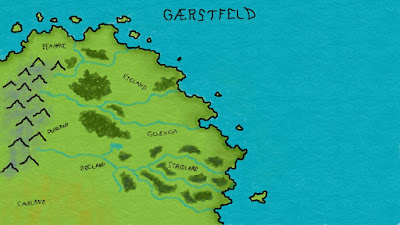
About a thousand years ago, Gærstfeld was a sparsely populated frontier with only a few small settlements. During the great migration, however, many clans from the South and West came to this region in search of an opportunity at a better life. The lush and fertile countryside, fed by several river systems running from the Westhealf mountains to the coast, provided ample opportunity for the migrating clans to settle and start anew.
The people of Gærstfeld are mostly common workers such as farmers, fishermen, woodsmen, and craftsmen. The common folk are free, working for the betterment of their local villages, towns, and their families. Communities generally share the produce of their efforts, and any surplus is traded to nearby settlements. A certain taxation is in effect to the extent that the lord, or thegn, of each hold receives a portion of said produce and trade income so that he may use these to re-invest into his lands and ensure the stability of his holdings.
Each thegn may be in charge of a small village or rural region, or possibly just a small collection of farms or a mill. There are thousands of thegns in Gærstfeld, and although these landowners are more wealthy than the common folk, or ceorls, they are by no means above working with their people. A thegn may assert some level of local authority of law, but for the most part has no say beyond his small hold.
Above the rank of thegn is the bregu, or chief, a title left over from the old days of the nomadic clans. The bregu may lord over ten or twenty thegns, who owe loyalty to their chief usually more from ties of kinship than any political agreement. The bregu is in charge of maintaining the safety of the holds under his control and passing judgement over any disagreements or law breakers, and to serve this function may maintain an organized militia. The bregu usually is also the chief authority in most minor trading towns, and the thegns under his dominion usually oversee smaller settlements that trade with the bregu's town.
The bregu, in turn, owe loyalty to an ealdorman. Each ealdorman is in charge of what is the lowest official political region, the ealde. Each ealdorman may maintain a fortified keep and a standing garrison. Around these usually there has developed larger towns or small cities. The ealdorman will also be the governing figure in these settlements. The ealdorman is answerable to his cyning, or king, and is responsible not only for maintaining order in his own ealde, but may be called upon to raise and lead a military force when the cyning summons him.
Each cyning inherited his role from ancestral high chiefs who conquered, settled, or otherwise came to control vast swathes of land. Each of these demarcations is called a folde, and to this day operates mostly independently. Two foldes may come to blows over a disagreement, but the conflict must be kept brief and the loss of life to a minimum, lest the high king, or cynehláford, become involved. The foldes of Gærstfeld each used to be its own kingdom, but over two hundred years ago they were united by Bældon The Wise, the first high king. Since then, each cyning still rules his folde and maintains his own standing army, but owes allegiance to the high king.
There are seven foldes in Gærstfeld: Pearroc, Dunland, Eteland, Gelenda, Bocland, Stródland, and Eardland. Pearroc is sparsely populated and is characterized by harsh winters. Dunland is a land of rocky foothills near the Westhealf mountains and is the main producer of mineral resources. Eteland is, like Pearroc, not very heavily populated and consists mostly of coastal farming and fishing settlements. Gelenda is one of the more prosperous of the foldes, and is known for it's abundantly rich farmlands. Bocland is the seat of the cynehláford, or high king, and the center of government for the region. It also boasts bountiful farmland and prosperous stone quarries near the plains of Eardland. Eardland itself is the least populated and organized of the foldes, still consisting mostly of the old clan structures and not holding to the typical governmental structures as the other foldes. There are few ealdormen here, mostly in the lands closer to Bocland, and through most of the folde the bregu is the chief authority. The people of Eardland are known as expert horsemen. Stródland is a region of thick marshy forests run through with three rivers. There is not much farmland here, but the hunters and trappers of Stródland are without peer and many expert bowmen reside here.

The military of Gærstfeld is relatively small, as far as standing armies go. Each king may have only a few hundred professional soldiers, and the ealdorman usually much less, closer to fifty. The militia of the bregu may be full time or part time soldiers, usually the latter, and may number as few as a dozen men. Each thegn, however, is required to maintain mail, helm, shield, sword, and spear for himself and to ensure that all able bodied men under his authority are armed with a shield and spear or javelins. By doing this, the actual military might of Gærstfeld may be measured in the number of adult men who are fit enough to fight. All men are trained to fight in the shield wall, a formation of interlocking shields which creates a defensive bulwark of humanity bristling with spear points. Each man may not be a highly skilled warrior, but with hundreds of men side by side behind their shields, they must only stand their ground.
Thus concludes our brief overview of the geography, history, politics, and military of Gærstfeld. This is just the beginning, however, and I anticipate developing this project further.
Gærstfeld is based on the Anglo-Saxon era of England. It is a country consisting mostly of open, rolling plains run through with rivers and dotted with forests. It is an idyllic countryside; ripe for farming and rich with resources such as wood from the forests, minerals from the mountains, and a long coastline with ample fisheries.

About a thousand years ago, Gærstfeld was a sparsely populated frontier with only a few small settlements. During the great migration, however, many clans from the South and West came to this region in search of an opportunity at a better life. The lush and fertile countryside, fed by several river systems running from the Westhealf mountains to the coast, provided ample opportunity for the migrating clans to settle and start anew.
The people of Gærstfeld are mostly common workers such as farmers, fishermen, woodsmen, and craftsmen. The common folk are free, working for the betterment of their local villages, towns, and their families. Communities generally share the produce of their efforts, and any surplus is traded to nearby settlements. A certain taxation is in effect to the extent that the lord, or thegn, of each hold receives a portion of said produce and trade income so that he may use these to re-invest into his lands and ensure the stability of his holdings.
Each thegn may be in charge of a small village or rural region, or possibly just a small collection of farms or a mill. There are thousands of thegns in Gærstfeld, and although these landowners are more wealthy than the common folk, or ceorls, they are by no means above working with their people. A thegn may assert some level of local authority of law, but for the most part has no say beyond his small hold.
Above the rank of thegn is the bregu, or chief, a title left over from the old days of the nomadic clans. The bregu may lord over ten or twenty thegns, who owe loyalty to their chief usually more from ties of kinship than any political agreement. The bregu is in charge of maintaining the safety of the holds under his control and passing judgement over any disagreements or law breakers, and to serve this function may maintain an organized militia. The bregu usually is also the chief authority in most minor trading towns, and the thegns under his dominion usually oversee smaller settlements that trade with the bregu's town.
The bregu, in turn, owe loyalty to an ealdorman. Each ealdorman is in charge of what is the lowest official political region, the ealde. Each ealdorman may maintain a fortified keep and a standing garrison. Around these usually there has developed larger towns or small cities. The ealdorman will also be the governing figure in these settlements. The ealdorman is answerable to his cyning, or king, and is responsible not only for maintaining order in his own ealde, but may be called upon to raise and lead a military force when the cyning summons him.
Each cyning inherited his role from ancestral high chiefs who conquered, settled, or otherwise came to control vast swathes of land. Each of these demarcations is called a folde, and to this day operates mostly independently. Two foldes may come to blows over a disagreement, but the conflict must be kept brief and the loss of life to a minimum, lest the high king, or cynehláford, become involved. The foldes of Gærstfeld each used to be its own kingdom, but over two hundred years ago they were united by Bældon The Wise, the first high king. Since then, each cyning still rules his folde and maintains his own standing army, but owes allegiance to the high king.
There are seven foldes in Gærstfeld: Pearroc, Dunland, Eteland, Gelenda, Bocland, Stródland, and Eardland. Pearroc is sparsely populated and is characterized by harsh winters. Dunland is a land of rocky foothills near the Westhealf mountains and is the main producer of mineral resources. Eteland is, like Pearroc, not very heavily populated and consists mostly of coastal farming and fishing settlements. Gelenda is one of the more prosperous of the foldes, and is known for it's abundantly rich farmlands. Bocland is the seat of the cynehláford, or high king, and the center of government for the region. It also boasts bountiful farmland and prosperous stone quarries near the plains of Eardland. Eardland itself is the least populated and organized of the foldes, still consisting mostly of the old clan structures and not holding to the typical governmental structures as the other foldes. There are few ealdormen here, mostly in the lands closer to Bocland, and through most of the folde the bregu is the chief authority. The people of Eardland are known as expert horsemen. Stródland is a region of thick marshy forests run through with three rivers. There is not much farmland here, but the hunters and trappers of Stródland are without peer and many expert bowmen reside here.

The military of Gærstfeld is relatively small, as far as standing armies go. Each king may have only a few hundred professional soldiers, and the ealdorman usually much less, closer to fifty. The militia of the bregu may be full time or part time soldiers, usually the latter, and may number as few as a dozen men. Each thegn, however, is required to maintain mail, helm, shield, sword, and spear for himself and to ensure that all able bodied men under his authority are armed with a shield and spear or javelins. By doing this, the actual military might of Gærstfeld may be measured in the number of adult men who are fit enough to fight. All men are trained to fight in the shield wall, a formation of interlocking shields which creates a defensive bulwark of humanity bristling with spear points. Each man may not be a highly skilled warrior, but with hundreds of men side by side behind their shields, they must only stand their ground.
Thus concludes our brief overview of the geography, history, politics, and military of Gærstfeld. This is just the beginning, however, and I anticipate developing this project further.
Subscribe to:
Posts (Atom)